Category Archives: art news

A History of Jewellery

A History of Jewellery

Ancient world jewellery

Jewellery is a universal form of adornment. Jewellery made from shells, stone and bones survives from prehistoric times. It is likely that from an early date it was worn as a protection from the dangers of life or as a mark of status or rank.

In the ancient world the discovery of how to work metals was an important stage in the development of the art of jewellery. Over time, metalworking techniques became more sophisticated and decoration more intricate.

Gold, a rare and highly valued material, was buried with the dead so as to accompany its owner into the afterlife. Much archaeological jewellery comes from tombs and hoards. Sometimes, as with the gold collars from Celtic Ireland which have been found folded in half, it appears people may have followed a ritual for the disposal of jewellery.

This collar was found in a bog in Shannongrove, Co. Limerick, Ireland, sometime before 1783. We do not know what it was used for, but it was probably a ceremonial collar. On the inner side of the collar, under each of the circular terminals, is a hole. The collar probably rested on the chest and was held in place by a chain running between the two holes and passing round the back of the neck.

2006an7353 collar
Collar known as The Shannongrove Gorget, maker unknown, late Bronze Age (probably 800-700 BC), Ireland. Museum no. M.35-1948. © Victoria & Albert Museum, London

Medieval jewellery 1200–1500

The jewellery worn in medieval Europe reflected an intensely hierarchical and status-conscious society. Royalty and the nobility wore gold, silver and precious gems. Lower ranks of society wore base metals, such as copper or pewter. Colour (provided by precious gems and enamel) and protective power were highly valued. Some jewels have cryptic or magical inscriptions, believed to protect the wearer.

Until the late 14th century, gems were usually polished rather than cut. Size and lustrous colour determined their value. Enamels - ground glasses fired at high temperature onto a metal surface - allowed goldsmiths to colour their designs on jewellery. They used a range of techniques to create effects that are still widely used today.

The images decorating the back of this cross were often used as a focus for meditation in the late medieval period. The scenes on the lid show the Instruments of the Passion - scourge, whip, lance, sponge and nails - which were used during the Crucifixion. A tiny fragment of one of them may have formed a relic, stored within the cross’s now empty interior. Pearls symbolised purity, and the red gems may have symbolised sacrificial blood shed by Christ.

2006ac3993 pendant
Pendant reliquary cross, unknown maker, about 1450-1475, Germany. Museum no. 4561-1858. © Victoria and Albert Museum, London

Renaissance jewellery

Renaissance jewels shared the age's passion for splendour. Enamels, often covering both sides of the jewel, became more elaborate and colourful and advances in cutting techniques increased the glitter of stones.

The enormous importance of religion in everyday life could be seen in jewellery, as could earthly power - many spectacular pieces were worn as a display of political strength. The designs reflect the new-found interest in the classical world, with mythological figures and scenes becoming popular. The ancient art of gem engraving was revived and the use of portraits reflected another cultural trend - an increased artistic awareness of the individual.

Particular types of stone were thought to protect against specific ailments or threats, ranging from toothache to the evil eye. They could also encourage or banish such characteristics as bravery or melancholy. This scorpion etching dates from the 2nd or 1st century BC but has been reused in a medieval ring. Carved Greek or Roman stones were highly valued in the middle ages. They were found in excavations or in surviving earlier pieces of jewellery and traded across Europe. The scorpion had an enduring reputation as a protective amulet. It was believed to heal patients from poisoning and also, as symbol of the Zodiac sign Scorpio, it was associated with water and therefore believed to have a cooling effect on fever. Remedies against poisoning were also made by infusing scorpions in oil and herbs. The Medici Grand Duke Francesco I (d. 1587) published a recipe for an anti-poison oil effective against 'all sorts of poisons ingested by mouth, stings and bites'.

Scorpion
Ring, maker unknown, setting 15th century, centre 2nd century BC-1st century BC. Museum no. 724-1871. © Victoria & Albert Museum, London

17th-century jewellery

By the mid-17th century, changes in fashion had introduced new styles of jewellery. While dark fabrics required elaborate gold jewellery, the new softer pastel shades became graceful backdrops for gemstones and pearls. Expanding global trade made gemstones ever more available. Advances in cutting techniques increased the sparkle of gemstones in candlelight.

The most impressive jewels were often large bodice or breast ornaments, which had to be pinned or stitched to stiff dress fabrics. The swirling foliate decoration of the jewels shows new enthusiasm for bow motifs and botanical ornaments. The central bow in this necklace is a magnificent example of a mid-17th century jewel. The painted opaque enamel was a recent innovation, said to have been developed by a Frenchman, Jean Toutin of Châteaudun. This striking colour combination was frequently used in enamels around this date.

Front necklace
Necklace with Sapphire Pendant, bow about 1660, chain and pendant probably 18-1900, Europe. Museum no. M.95-1909. © Victoria & Albert Museum, London

18th-century jewellery

The end of the previous century had seen the development of the brilliant-cut with its multiple facets. Diamonds sparkled as never before and came to dominate jewellery design. Frequently mounted in silver to enhance the stone's white colour, magnificent sets of diamond jewels were essential for court life. The largest were worn on the bodice, while smaller ornaments could be scattered over an outfit.

Owing to its high intrinsic value, little diamond jewellery from this period survives. Owners often sold it or re-set the gems into more fashionable designs.

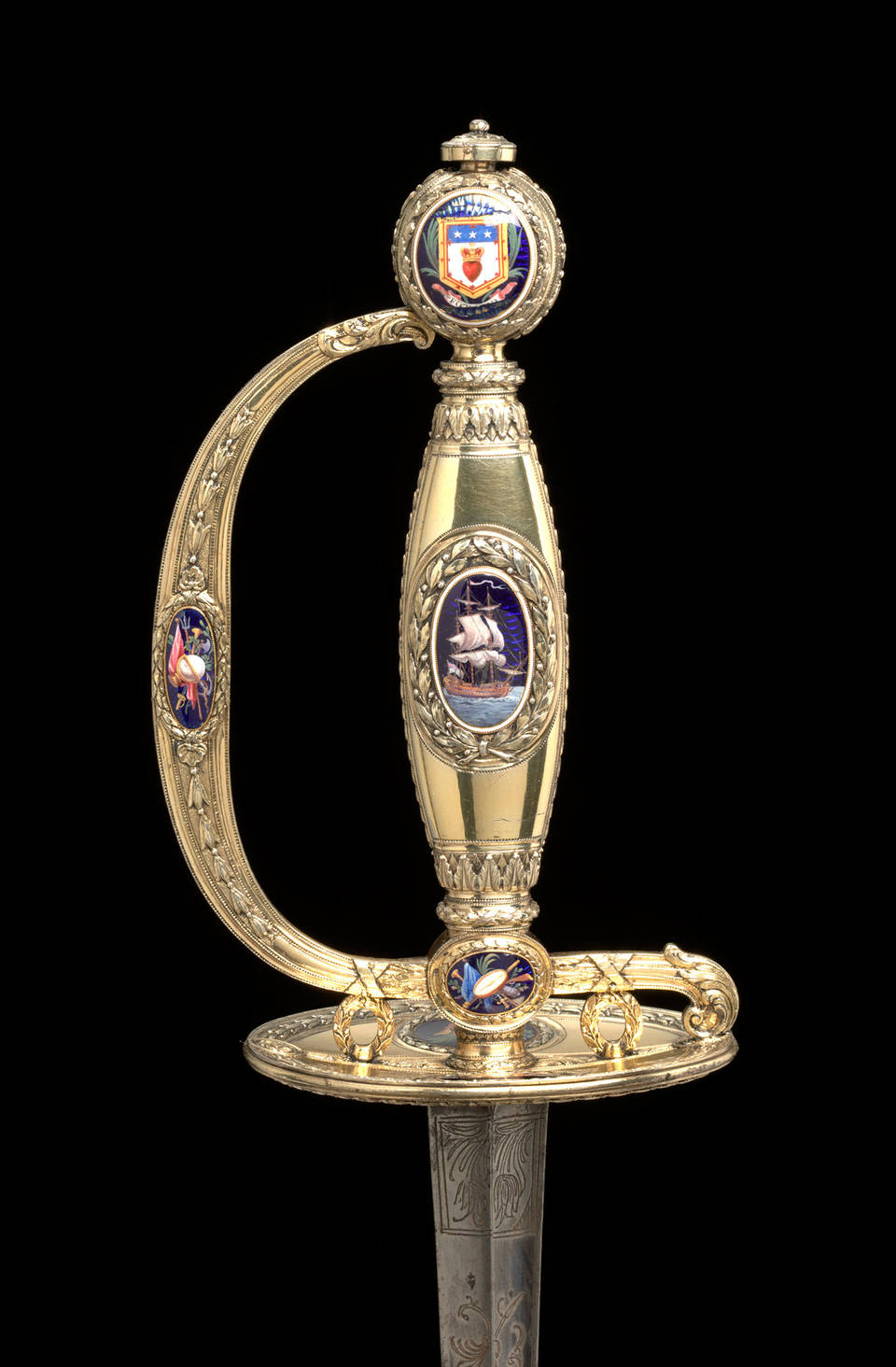
From around 1640, light swords with short, flexible, pointed blades appeared in response to new fencing techniques that emphasised thrusting at speed. They were worn increasingly with civilian clothes as ‘small swords’, offering a means of self-defence but largely denoting status for the well-dressed gentleman.

Small swords were items of male jewellery. By the 1750s, their elaborate gold and silver hilts, mounted with precious stones and fine enamelling, were the products of the goldsmith and jeweller rather than the swordsmith. They were often given as rewards for distinguished military and naval service.

This sword is inscribed: ‘PRESENTED by the Committee of Merchants &c OF LONDON to LIEUT.T FRANCIS DOUGLAS for his Spirited and active conduct on board His Majesty’s Ship the REPULSE. Ja.s Alms Esq.r Commander during the MUTINY at the NORE in 1797. Marine Society Office, May 1o 1798 } Hugh Inglis Esq.r Chairman’.

2008bt1108 sword
Sword, mark of James Morisset, 1798-9, England. Museum no. 274-1, 2-1869. © Victoria & Albert Museum, London

Francis Douglas was rewarded for his role in suppressing a violent mutiny among sailors at the Nore, a Royal Navy anchorage in the Thames Estuary in 1797. According to an account by an eyewitness, published in The Sheerness Guardian 70 years later, the ship, Repulse, made a 'miraculous' escape from the mutineers reaching shore despite receiving 'as was calculated two hundred shot'.

James Morisset, one of London’s most celebrated makers of enamelled gold dress-swords and boxes, was commissioned to produce this sword.

19th-century jewellery

The 19th century was a period of huge industrial and social change, but in jewellery design the focus was often on the past. In the first decades classical styles were popular, evoking the glories of ancient Greece and Rome. This interest in antiquities was stimulated by fresh archaeological discoveries. Goldsmiths attempted to revive ancient techniques and made jewellery that imitated, or was in the style of, archaeological jewellery.

There was also an interest in jewels inspired by the Medieval and Renaissance periods. It is a testament to the period's eclectic nature that jewellers such as the Castellani and Giuliano worked in archaeological and historical styles at the same time.

Naturalistic jewellery, decorated with clearly recognisable flowers and fruit, was also popular for much of this period. These motifs first became fashionable in the early years of the century, with the widespread interest in botany and the influence of Romantic poets such as Wordsworth. This large spray of assorted flowers has a pin fastening at the back and would have been worn as a bodice ornament. Some of the diamond flowers are set on springs, which would increase their sparkle considerably as the wearer moved. Individual flower sprays could be removed and used as hair ornaments.

By the 1850s the delicate early designs had given way to more extravagant and complex compositions of flowers and foliage. At the same time, flowers were used to express love and friendship. The colours in nature were matched by coloured gemstones, and a 'language of flowers' spelt out special messages. In contrast with earlier periods, the more elaborate jewellery was worn almost exclusively by women.

2006aa4840 brooch
Collar known as The Shannongrove Gorget, maker unknown, late Bronze Age (probably 800-700 BC), Ireland. Museum no. M.35-1948. © Victoria & Albert Museum, London

Arts & crafts jewellery

Developing in the last years of the 19th century, the Arts and Crafts movement was based on a profound unease with the industrialised world. Its jewellers rejected the machine-led factory system - by now the source of most affordable pieces - and instead focused on hand-crafting individual jewels. This process, they believed, would improve the soul of the workman as well as the end design.

Arts and Crafts jewellers avoided large, faceted stones, relying instead on the natural beauty of cabochon (shaped and polished) gems. They replaced the repetition and regularity of mainstream settings with curving or figurative designs, often with a symbolic meaning.

The designer of this brooch, C. R. Ashbee, was a man of immense talents and energy and a defining figure in the Arts and Crafts Movement. In 1888 he founded the Guild of Handicraft in the East End of London with the intention of reviving traditional craft skills and providing satisfying employment in a deprived area of the city. Trained originally as an architect, he is known also for his highly innovative furniture, metalwork, silver and jewellery designs.

The peacock was one of Ashbee's favourite and most distinctive motifs and he is known to have designed about a dozen peacock jewels in the years around 1900. Family tradition is that this brooch was designed for his wife, Janet. It was made by Ashbee's Guild of Handicraft Ltd. at Essex House on the Mile End Road, London.

Earings
Pendant-brooch (detail), designed by C.R. Ashbee and made by the Guild of Handicraft, about 1900, England. Museum no. M.31-2005. © Victoria & Albert Museum, London

Art Nouveau jewellery and the Garland style 1895–1910

The Art Nouveau style caused a dramatic shift in jewellery design, reaching a peak around 1900 when it triumphed at the Paris International Exhibition.

Its followers created sinuous, organic pieces whose undercurrents of eroticism and death were a world away from the floral motifs of earlier generations. Art Nouveau jewellers like René Lalique also distanced themselves from conventional precious stones and put greater emphasis on the subtle effects of materials such as glass, horn and enamel.

However, the style's radical look was not for everyone or for every occasion. Superb diamond jewellery was made in the 'garland style', a highly creative re-interpretation of 18th- and early 19th-century designs.

The maker of this orchid hair ornament, Philippe Wolfers, was the most prestigious of the Art Nouveau jewellers working in Brussels. Like his Parisian contemporary René Lalique, he was greatly influenced by the natural world. These exotic orchids feature in the work of both. The technical achievement of enamelling in plique-a-jour (backless) enamel on these undulating surfaces is extraordinary.

2006an9908 hair ornament
Hair ornament, made by Philippe Wolfers, 1905-7, Belgium. Museum no. M.11-1962. © Victoria & Albert Museum, London

Art Deco jewellery to the 1950s

Although buffeted by cycles of boom, depression and war, jewellery design between the 1920s and 1950s continued to be both innovative and glamorous. Sharp, geometric patterns celebrated the machine age, while exotic creations inspired by the Near and Far East hinted that jewellery fashions were truly international. New York now rivalled Paris as a centre for fashion, and European jewellery houses could expect to sell to, as well as buy from, the Indian subcontinent.

Dense concentrations of gemstones are characteristic of Art Deco jewellery. From about 1933 gold returned to fashion, partly because it was cheaper than platinum.

Artists and designers from other fields also became involved in jewellery design. Their work foreshadows the new directions jewellery would take.

This brooch commemorates the breaking of the World Land Speed Record by Captain George Eyston in 1937. The car depicted is Thunderbolt, which Captain Eyston designed, built and drove. It was powered by two aero engines made by the firm of Rolls-Royce, which presented the brooch to Captain Eyston’s wife.

2006ax6177 commemorative brooch
Commemorative Brooch, 1937, England. Museum no. M.115-1993. © Victoria & Albert Museum, London

Contemporary jewellery

Since the 1960s the boundaries of jewellery have been continually redefined. Conventions have been challenged by successive generations of independent jewellers, often educated at art college and immersed in radical ideas.

New technologies and non-precious materials, including plastics, paper and textiles, have overturned the notions of status traditionally implicit in jewellery.

Avant-garde artist-jewellers have explored the interaction of jewellery with the body, pushing the boundaries of scale and wearability to the limits. Jewellery has developed into wearable art. The debate on its relationship to Fine Art continues.

2008br8672 malcolm appleby
Brooch, designed and engraved by Malcolm Appleby, made by Roger Doyle, 1975, England. Museum no. M.314-1977. © Victoria & Albert Museum, London

Published by V&A, Victoria and Albert Museum

modern art

What Is Modern Art?

What Is Modern Art?

Late-19th-century artists broke with tradition to create art for the modern age.

The birth of modernism and modern art can be traced back to the Industrial Revolution, a period that lasted from the 18th to the 19th century, in which rapid changes in manufacturing, transportation, and technology profoundly affected the social, economic, and cultural conditions of life in Western Europe, North America, and eventually the world. New forms of transportation, including the railroad, the steam engine, and the subway changed the way people lived, worked, and traveled, both at home and abroad, expanding their worldview and access to new ideas. As urban centers prospered, workers flocked to cities for industrial jobs, and urban populations boomed.

A Modern Art

Prior to the 19th century, artists were most often commissioned to make artwork by wealthy patrons, or institutions like the church. Much of this art depicted religious or mythological scenes that told stories and were intended to instruct the viewer. During the 19th century, many artists started to make art about people, places, or ideas that interested them, and of which they had direct experience. With the publication of psychologist Sigmund Freud’s The Interpretation of Dreams (1899) and the popularization of the idea of a subconscious mind, many artists began exploring dreams, symbolism, and personal iconography as avenues for the depiction of their subjective experiences.

Challenging the notion that art must realistically depict the world, some artists experimented with the expressive use of color, non-traditional materials, and new techniques and mediums. One of these was photography, whose invention in the 1830s introduced a new method for depicting and reinterpreting the world. The Museum of Modern Art collects work made after 1880, when the atmosphere was ripe for avant-garde artists to take their work in new, unexpected, and “modern” directions.

Published by MoMA, The Museum of Modern Art

video-art

Video Art

Video art, 10 of the best artists working with the medium today

Video art is often considered impenetrably abstract and far beyond the comprehension of everyday art-lovers. But if you’ve ever secretly wanted a route into this bizarre and dreamlike world, here are 10 of the best artists working with the medium today.

Video footage is the smudge-faced Cinderella of the art world. While sculpture, painting and photography get glammed up to be fawned upon by countless admirers at the ball, video’s invitation is all-too-often overlooked because it seems too pretentious or confusing.

Yet such a blinkered view negates the fact that video artists are some of the most important creatives working today, and the medium is going from strength to strength. In many ways moving footage is the perfect means of satire and critique of our modern, media-obsessed age, being one of the youngest major artforms around by some degree.

So, if the world of video art still remains as murky, obscure and indecipherable to you as a screen full of static or an after-hours test screen, read on for our list of ten of the most important names you need to know to begin cracking this most exciting of genres

Christian Marclay
If you have even a passing acquaintance with video art, you’re probably familiar with The Clock (2010), which is perhaps the most hyped art film of recent years. The premise was deceptively simple: it ran for 24 hours and was a mash-up of movie scenes featuring either a clock face or a reference to time that was synonymous with the actual time. So, if you were watching the film at half-past three, half-past three would be referenced either visually or verbally (or both). It brought out a ruthless pub quiz instinct in viewers, prompting you to hunt desperately for the time reference in each scene before it ended. Cue queues around the block and all-night viewings.

The hype is not unjustified. Marclay’s been a Very Big Deal in the worlds of art and sound since the late ’70s, when, according to critic Thom Jurek, he was perhaps “the unwitting inventor of turntablism.” Marclay’s credo is to take “images and sounds that we’re all familiar with and reorganize them in a way that is unfamiliar” and although The Clock is still touring five years after it was first aired (currently showing at LACMA in LA, if you’re interested), Marclay’s not resting on his laurels. This year he had a multimedia exhibition at London’s Bermondsey White Cube, which was composed of paintings, audio and, a centerpiece video: Pub Crawl (2015). This installation of 11 videos focused on the artist’s feet as he navigates the city streets showing the destruction of the Saturday night before.

Pipilotti Rist

Pipilotti Rist, AKA Elisabeth Charlotte Rist, is a Swiss video artist who’s been making statements about gender, the body, sexuality and pop culture through her videos since her first breakthrough hit, I’m Not The Girl Who Misses Much (1986).

Rist went quiet for a few years after the millennium, claiming she felt burnt out, but her big comeback was Pour Your Body Out (7534 Cubic Meters) (2008) – a kaleidoscopic video work which was made to fit the proportions of MoMA’s intimidating second-floor lobby atrium. When it showed, it attracted over 6,000 visitors per day, and reflected what the New York Times called Rist’s “obsessive curiosity about nature,” with sweeping close-ups of lush tulips, ripe strawberries and apples juxtaposed with abrupt moments of disgust.

While Rist’s work has been criticised for being too accessible — often made up of the sort of colorful quirkiness you might find in a particularly avant-garde music video — she argues that video work is comparable to a particularly spacious woman’s handbag. That is to say, it’s a medium with “room in for everything: painting, technology, language, music, lousy flowing pictures, poetry, commotion, premonitions of death, sex and friendliness.”

There’s no better introduction to Rist’s work than her 1997 video Ever Is Over All, with its distinctive combination of bright color, femininity and playfulness laying the groundwork for what would follow.

Cory Archangel

If Urban Outfitters made artists, then Cory Arcangel would likely be the product of their labors. This Brooklyn-based multimedia bro’s work deals with what he calls “the preservation of obsolete technology,” and obsessively harnesses the dubious power of everyone’s favorite font: Comic Sans MS. This translates to the hacking of old-school video games to comic effect, the programming of drum machines to play retro beats on loop and the creation of humorous YouTube collages – though admittedly, all with a palpable sense of warmth and affection for his subjects.

His most famous work is Super Mario Clouds (2002), where he physically hacked a Nintendo Super Mario game cartridge so all that was visible are the clouds sailing lethargically against a backdrop of blue sky on loop. This allowed viewers to cloud-watch digitally, much in the same way they might do in “real life.” While the YouTube video merely shows the actual footage, when exhibited, the work was projected on many different screens at different heights and of different sizes, creating something surreally immersive.

A few years later, he created the video collage a couple thousand short films about Glenn Gould (2007) , a masterpiece of editing which took clips of amateur musicians playing instruments on YouTube and spliced them together to create a reconstruction of the first of Johannes Sebastian Bach’s “Goldberg Variations.” This followed on from something arguably much more fun: a YouTube video that painstakingly edited together footage of cats walking on pianos to create Arnold Schoenberg’s classic atonal piano piece “Drei Klavierstücke.”

Hannah Black

Black’s short, snappy meditations on pop culture may at first glance seem like cute bits of celebrity – her Team Jolie (2013) video, for example, explores the way love rivals Jennifer Aniston and Angelina Jolie are perceived in popular culture – but you only need to peruse this intimidatingly smart British artist/writer’s articles for The New Inquiry to see how much theory and philosophy go into her ideas.

A standout piece is her film My Bodies (2014), which assembles audio clips of black female recording artists (Rihanna, Beyonce, Whitney, Ciara ) singing the phrase “my body” and lays them over a montage of images of wealthy white men (Black describes Googling the words “CEO” and “executive” to source the images). The images are so close up the viewer almost gets lost in their pores, creating a surreal, disjointed commentary on traditional biases surrounding race and gender.

Ryan Trecartin

It’s hard to talk about video art wunderkind Ryan Trecartin without gushing, so let’s try and stick to the facts. Born in Texas in 1981, currently residing in LA, Trecartin makes colourful, jarringly surreal videos that challenge a New York-centric, heteronormative vision of art in the framework of everything digital.

He first gained international attention with his 2004 opus A Family Finds Entertainment, in which the main character, Skippy, locks himself in the cupboard of a bathroom at his own house party, comes out to his parents as gay, runs out into the road and then gets run over by a car, before he is magically resurrected. His videos are exactly as hyperactive and confusing as this description implies, and generally feature an ensemble of Trecartin’s pals, garishly attired, improvising lines that are repeated over and over.

As Trecartin’s star ascended, he was chosen to show a set of immersive videos in the career-making “The Generational: Younger Than Jesus” show at the New Museum in 2009, while his much-lauded series of seven videos focusing on corporate life and personal branding, Any Ever (2010-2011), confirmed that things could only get better. Trecartin is endlessly prolific, so if you’ve got some spare time to go down the lurid rabbit hole, check out the video above before exploring his Vimeo profile.

Cyprien Gaillard
Gaillard was first fêted at the same “Younger Than Jesus“ show as Trecartin. However, his work is worlds away from the hyperactive technicolor of a Trecartin film. Gaillard is based in Berlin, but hails from France, and his works are primarily concerned with destruction and reaction to nostalgia.

Perhaps the best introduction to Gaillard’s work is Desniansky Raion, a short which documents the St Petersburg subculture of fight clubs. The video opens on a housing project in the suburbs of St. Petersburg, with the camera’s gaze sweeping over drab, Brutalist-style buildings before cutting to two groups of men marching towards each other, one group mostly attired in red, the other group mostly in blue. As flares are set off, the groups fall on each other, pummelling each other with unrestrained violence.

This violence is key to Gaillard’s work, whether focused on people (as in Desniansky), or place, as we see in Artefacts (2011), which shoots scenes from post-conflict Iraq and juxtaposes them against images of Babylon’s antiquities. The piece was shot on the artist’s iPhone and the digital video was then transferred to an older 35mm format on which the work is looped.

Andrew Thomas Huang

Not many artists can count Lost creator J.J. Abrams as a fan of their early work. That said, not many artists have produced a debut film that was nominated for Best of YouTube in 2007 and watched by over six million people. Huang’s breakout film Doll Face is equal parts inventive and unsettling, acting as a searing (if not exactly subtle) critique of the influence TV has on our self-image.

While Huang took a meeting with Abrams the day after graduating USC, he resolved to stick with the short film medium until he struck upon exactly the right subject for a longer feature. Since then, he’s directed adverts for brands like Google and Lexus and music videos for artists like Avi Buffalo and Delphic.

After raising $8,000 via Kickstarter for a new art project, Huang directed the 10-minute technicolor short “Solipsist,” which won the 2012 Special Jury Prize for Experimental Short Film at Sundance and was an Official Selection at the San Francisco International Film Festival.

Abrams isn’t Huang’s only famous fan. This year, he has spent most of his time collaborating with none other than Björk. The pair worked together on a 360-degree virtual reality video for her song “Stonemilker,” where viewers could interact with the video at MoMA PS1 in Long Island City or at the Rough Trade shops in London or New York/ There was also a moving album cover for Vulnicura and an intense ten-minute video for the single “Black Lake”.

His website currently has a graphic titled “coming soon: FALL 2015”, so stay tuned for more outbursts of dark futurism later this year.

Gillian Wearing

Wearing is a London-based photographer and video artist who describes her work as “editing life.” She’s been a big name on the British art scene for decades and is so ultra-established that she’s both won the Turner Prize and has been elected as a lifetime member of the Royal Academy of the Arts in London. She uses the camera to explore the gap between people’s public and private lives and plays with identity, asking adults to lip sync to the recorded confessions of children or to disguise themselves with ultra realistic masks.

Last year, Wearing’s 21-minute film We Are Here showed at Maureen Paley’s landmark gallery in East London, exploring the interior monologues of a number of people who turn out to be “shades” (i.e. dead voices speaking from the afterlife), in an unidentified community space. The stories explore the isolation people experienced in their lifetime, whether from repressing one’s feelings to the loneliness a serious illness can provoke.

Her most recent project is a little less bleak, crowdsourcing the views from people’s windows and aiming to edit them together into one subtly emotional piece. This project appears to still be open for submissions, so if the idea of your bedroom view becoming the video art star of tomorrow appeals, submit here.

Luke Fowler

37-year-old artist, filmmaker and musician Luke Fowler is based in Glasgow. His videos are strikingly different to everything else listed here: whereas so many of the other artists I’ve name-checked look to the future, Fowler’s films focus on how to examine the past. While experimental, his films are far closer to documentaries than they are to stereotypical wacky video-art fare, but this hasn’t done much to hurt his chances in the art world. In 2008 he won the inaugural Derek Jarman Award, while in 2012 he was shortlisted for the prestigious Turner Prize.

His cinematic collages have explored figures as diverse as famed Scottish psychiatrist R.D. Laing, who wrote extensively on schizophrenia, and experimental English composer Cornelius Cardew, while his film Depositions (2014), ran on the BBC last year and dwells on “potentiality: what might be, what might have been, what might still be if the world were to turn in a different direction?”

Shana Moulten

Adjectives people usually associate with video art: disturbing, overwhelming, pretentious, provocative. One adjective people don’t associate with video art so often: funny.

That’s why it’s a damn shame that Shana Moulton is so peculiarly under-hyped. While her video art’s highly influenced by Trecartin, it’s far more overtly humorous and accessible than his work. Her series “Whispering Pines” centers around her neurotic alter-ego, Cynthia, who’s a hypochondriac with a passion for new age kitsch, lurid decoration schemes, sand art, journaling and terrible haircuts. Think: Twin Peaks’ the Log Lady meets Amy Schumer.

I don’t know if Enya-based humor has the same impact as everyone else as it does on me, but I laughed forever at this…


Words by Sophie Atkinson for Highsnobiety.com

sculpture

History of Sculpture

History of Sculpture

Introduction

Any chronological account of the origins and evolution of three-dimensional art should properly occupy several volumes, if not a whole library of books. Compressing it into a single page means that most of the story is unavoidably omitted. Even so, it's still a great story! From Prehistory, through Classical Antiquity, the Gothic era, the Renaissance to the 21st century, the history of sculpture is filled with extraordinary artists - most sadly anonymous - whose visual expressiveness remains with us in the form of wonderful marble statues, stone reliefs, and immortal bronzes.

Even today, visit any cathedral, or any of the great cities, squares or buildings of the world, and you are certain to see great examples of 3-D art.

Chronology of Fine Art Sculpture

Prehistoric Sculpture

Sculpture begins in the Stone Age. Exactly when, we don't know. The earliest known examples are the two primitive stone effigies known as The Venus of Berekhat Ram and The Venus of Tan-Tan. The Venus of Berekhat Ram (dating from c.230,000 BCE or earlier) is a basaltic figurine made during the Acheulian Period, which was discovered on the Golan Heights. The Venus of Tan-Tan (c.200,000 BCE or earlier) is a quartzite figurine from the same period.

If these objects are pre-sculptural forms, the earliest prehistoric sculpture proper emerged around 35,000 BCE in the form of carvings of animals, birds, and therianthropic figures, made during the Lower Perigordian/Aurignacian Period and discovered in the caves of Vogelherd, Hohle Fels, and Hohlenstein-Stadel, in the Swabian Jura, Germany. The earliest figurative sculpture is the ivory carving known as the Lion Man of the Hohlenstein Stadel (38,000 BCE).
Another early type of Stone Age sculpture are the miniature obese figurines called Venuses: such as the Venuses of Willendorf, Kostenky, Monpazier, Dolni Vestonice, Moravany, Brassempouy, and Gagarino. Made from materials as varied as mammoth bone, ceramic clay and bone ash, as well as various types of stone like steatite, oolitic limestone, serpentine, and volcanic rock, these venus figures have been located in sites across Europe, from Russia to Spain. Anthropologists believe they may have been used in fertility rituals, although why fat women should be so iconic remains a mystery. (Lack of food? Ed).

Mesolithic Sculpture (c.10,000-4,000 BCE)

Mesolithic art witnessed more bas-reliefs and free standing sculpture such as the anthropomorphic figurines unearthed in Nevali Cori and Gobekli Tepe near Urfa in eastern Turkey, and the statues of Lepenski Vir (eg. The Fish God) in Serbia. It also witnessed the creation of the Shigir Idol (7,500 BCE) - the world's oldest surviving wood carving - found near Sverdlovsk in Russia. Arguably the greatest Mesolithic work of art is the terracotta sculpture from Romania, known as The Thinker of Cernavoda, an unmistakable image of cognitive thought.

Neolithic Sculpture (c.4,000-2,000 BCE)

Neolithic art is noted above all for its pottery, but it also featured free standing sculpture and bronze statuettes - in particular from the Indus Valley Civilization, the North Caucasus and pre-Columbian art in the Americas. The most spectacular form of Neolithic art was Egyptian pyramid architecture whose burial chambers led to an increased demand for various types of reliefs as well as portable statues and statuettes. (See Egyptian sculpture.) Indeed, the advent of the Bronze Age (In Europe: 3000-1200 BCE) as well as the emergence of cities and public buildings, and the development of more sophisticated tools, triggered a general increase in the demand for all types of art, including sculpture. See, for instance, Mesopotamian sculpture (3000-500). It was during this era that art began to assume a significant role in reflecting the aspirations of powerful rulers and the deities they worshipped. In short, prosperous and ambitious communities were good for sculpture.

Eastern Mediterranean Sculpture (c.2000-1100 BCE)

Following the flowering of architecture and other arts in Egypt, the Levant also witnessed the rise of the Minoan culture on the island of Crete, which was noted for its sculpture and metalwork. After an unknown catastrophe (probably earthquake) around 1500 BCE, the Minoan civilization collapsed, and Crete was conquered by the Myceneans from the Greek mainland, who were themselves overcome and the city of Mycenae destroyed around 1100 BCE.

Far Eastern Sculpture (c.1700 BCE - 1150 CE)

Chinese art during the Shang Dynasty (c.1600-1050) developed along quite different lines to Western varieties. For the finest bronze sculpture produced in China during this period, see: Sanxingdui Bronzes (1200-1000 BCE). Famous examples of Indian and South-East Asian sculpture include the extraordinary reliefs at the 11th century Kandariya Mahadeva Hindu Temple (1017-29) in Madhya Pradesh, India; and the 12th century Angkor Wat Khmer Temple (1115-45) in Cambodia.

Sculpture of Classical Antiquity (c.1100-100 BCE)

Due to the cultural stagnation of the Greek "Dark Ages" (1100-900 BCE) and the predominance of pottery during the Geometric Period (900-700 BCE), Greek sculpture did not really appear until the Daedalic or Oriental-Style Period around 650 BCE. Thereafter it developed according to the traditional chronology of Greek art during classical antiquity, as follows: Archaic Period (c.650-500 BCE); Classical Period (c.500-323 BCE); and Hellenistic Period (c.323-100 BCE). For more, see: Greek Sculpture Made Simple.

Archaic Greek Sculpture (c.600-500 BCE)
The Archaic period was a time of slow but continuous experimentation; the most prized form of Archaic Greek sculpture was the kouros (pl.kouroi), or standing male nude.

Classical Greek Sculpture (c.500-323 BCE)
Divided into the Early Classical Period, High Classical Period and Late Classical Period, this was the high point of Greek creativity. In the plastic arts, famous sculptors like Polykleitos (5th century BCE), Myron (Active 480-444 BCE), and Phidias (c.488-431 BCE) (see his work at the Parthenon) achieved a level of realism - further developed by later artists such as Callimachus (Active 432-408 BCE), Skopas (Active 395-350 BCE), Lysippos (c.395-305 BCE), Praxiteles (Active 375-335 BCE), and Leochares (Active 340-320 BCE) - which would remain unsurpassed until the Italian Renaissance.

Hellenistic Greek Sculpture (c.323-27 BCE)
During this period (characterized by the spread of Greek culture throughout the civilized world), classical realism was replaced by greater heroicism and expressionism. See: Pergamene School of Hellenistic Sculpture (241-133 BCE). Famous works of Hellenistic Greek sculpture include: Dying Gaul by Epigonus; the Winged Victory of Samothrace; Laocoon and His Sons by Hagesandrus, Polydorus and Athenodorus (42-20 BCE), and the Venus de Milo. For the greatest Hellenistic reliefs, see: Pergamon Altar of Zeus (166-56 BCE).

Despite the political and military demise of the Greek City States from around 200 BCE, and the consequent rise of Rome, Greek sculpture retained its status as the finest ever made. Even the Romans failed to overcome their sense of inferiority in the face of Greek artistry, although they were cute enough to copy as many Greek works as possible, and it is largely through these copies that the art of Greek sculpture is known. The real influence of Hellenistic Statues and Reliefs actually occurred 1600-1700 years later when it was "rediscovered" by artists of the Early Renaissance in Italy, after which it formed the cornerstone of European art for the next four centuries. In short, the Greeks get maximum points.

Celtic Metal Sculpture (400-100 BCE)

Let's not forget the Celts - a series of nomadic tribes which emerged from the Caucasus around 800 BCE, and gradually spread westwards across Europe (600-100 BCE) as far as the Iberian peninsula, Britain and Ireland. Although highly mobile, and masters of blacksmithery and goldsmithery, they were too disorganized to compete with the highly disciplined and centralized State of Rome. Eventually wholly Romanized, at least on the Continent, their Celtic metalwork art included some of the finest metal sculpture of the age (eg. the Broighter Boat c.100-50 BCE). They were also exceptional traders and their intricate metalwork designs were exported and imitated throughout the known world. For stonework by the Celts, see: Celtic Sculpture. For monumental Keltoi stone sculpture, see: the Turoe Stone.

World's Greatest Clay Sculpture
The Terracotta Army (dating to 246-208 BCE), a huge collection of clay warriors and horses, was sculpted in Shaanxi province, China, under the orders of Emperor Qin Shi Huangdi. Thousands of figures remain buried at the site. See also Chinese Buddhist Sculpture (100-present). For art in India, see Indian sculpture (3300 BCE - 1850).

Roman Sculpture (c.200 BCE - c.200 CE)

Until about 27 BCE, despite the influence of earlier Etruscan sculptors - noted for their "joi de vivre" - Roman sculpture was unidealized and realistic; thereafter it became sternly heroic, and quite mediocre. It was designed above all to express the majesty and power of Roman rule, thus aside from a number of magnificent historical reliefs (eg. the spiral bas-relief of Trajan's Column) and rare monuments (eg. the Ara Pacis Augustae), Roman sculptors were largely employed in the production of portrait busts of the Emperors and other dignitaries. In short, no big deal.

Byzantine Sculpture (330-1450 CE)

Up until the fourth century, early Christian sculpture had been almost exclusively tomb reliefs for sarcophagi in Rome. When the Roman Empire divided into East and West, the Eastern capital was located in Constantinople. The art of the Eastern Roman Empire, based in Byzantium, was almost entirely religious, but, aside from some shallow ivory reliefs and goldsmithing, the Eastern Orthodox brand of Christianity did not permit 3-D artworks like statues or high reliefs. Good for painters, bad for sculptors.

Sculpture During The Dark Ages (c.500-800)

As the name suggests, this was a dark and quiet time for European sculptors. The Church was weak, the Barbarians (who weren't big into sculpture) were strong, and cities were impoverished and uncultured. There was some activity in Constantinople and on the fringes of Europe, for instance in Ireland, where (from 800-1100) the monastic church began commissioning a number of freestanding stone crosses known as Celtic High Cross sculptures - decorated with Gospel scenes and other Celtic-style patterns - but little medieval art was created on the Continent.

Note About Sculpture and Architecture

Before proceeding, it is worth emphasizing the key connection between public architecture or building programs, and sculpture. In simple terms, public buildings typically needed sculptural decoration, both inside and out. Supporting columns often incorporated decorative motifs or statues and reliefs, as did facades, doorways and various interior screens. Thus each new major program of public works - typically heralded by a new style of architecture - triggered a huge parallel program of sculpture. In short, Medieval sculptors loved architects.

Early Romanesque Sculpture (Carolingian, Ottonian) (c.800-1050)

The revival of medieval sculpture began with Charlemagne I, King of the Franks, who was crowned Holy Roman Emperor in 800. The Carolingian empire dissolved quite quickly but Charlemagne's patronage of the arts was a crucial first step in the revitalization of European culture, not least because many of the Romanesque and Gothic churches were built on the foundations of Carolingian architecture. Charlemagne's architectural achievements were continued by the Holy Roman Emperors Otto I, II and III, in a style known as Ottonian. So the art of sculpture was back, albeit on a modest scale. See also: Medieval Artists.

Romanesque Sculpture (c.1000-1200)

In the 11th century, a more confident Christian Church began to reassert itself. This doctrinal expansionism led to the Crusades to free the Holy Land from the grip of Islam. The Crusaders' success and their acquisition of Holy Relics triggered the construction of new churches and cathedrals across Europe in the fully fledged Romanesque style of architecture - a style known in Britain and Ireland as "Norman" architecture. This in turn led to a huge wave of commissions for Romanesque sculpture and stained glass. Thus finally, the art of sculpting was back. And with this new demand for plastic art came the establishment of new carving and modelling workshops, apprenticeships, and recognition for master-craftsmen. Indeed, by the 12th century the leading sculptors became highly sought-after by Abbots, Archbishops and other secular patrons, for their unique contribution to the visual impact of the religious buildings under construction.

Famous Romanesque Sculptors:
Gislebertus (12th century)
Master of Cabestany (12th century)
Master Mateo (12th century)
Benedetto Antelami (active 1178-1196)

Gothic Sculpture (c.1150-1300)

The Church's building program stimulated the development of new architectural techniques. These techniques came together during the mid-late 12th century in a style which Renaissance architects later dubbed "Gothic architecture". Characteristic Romanesque-style features such as rounded arches, massively thick walls and small windows and were replaced by pointed arches, soaring ceilings, thin walls and huge stained glass windows. This completely transformed the interior of many cathedrals into inspirational havens, where the Christian mesage was conveyed in a variety of Biblical art, including beautiful stained glass windows, and by a wide variety of sculpture. Cathedral facades and doorways were typically filled with sculptural reliefs depicting Biblical scenes, as well as rows of sculptures portraying Prophets, Apostles, ancient Kings of Judea, and other gospel figures. Interiors featured column statues and more reliefs, the whole thing being laid out according to an intricate plan of gospel iconography designed to educate and inspire illiterate worshippers.

In essence, the Gothic cathedral was intended to represent the Universe in miniature - a unique piece of Christian art designed to convey a sense of God's power and glory and the rational ordered nature of his worldly plan. Among the greatest homes of Gothic architectural sculpture are the French cathedrals of Notre Dame de Paris, Chartres, Reims, and Amiens; the German cathedrals of Cologne, Strasbourg and Bamberg, and the English churches of Westminster Abbey and York Minster - among many others. In summary, Gothic sculpture represented the high-point of monumental religious art. Although the Church would continue to invest heavily in the power of painting and sculpture to inspire the masses (notably in the Counter Reformation Baroque period), the Gothic era was really the apogee of "idealistic" religious artistry. Henceforth, the art of sculpture would become more and more enmeshed in secular as well as Papal politics.

Famous Gothic Sculptors:
Nicola Pisano (c.1206-1278)
Giovanni Pisano (c.1250-1314)
Arnolfo di Cambio (c.1240–1310)
Giovanni di Balduccio (c.1290–1339)
Andrea Pisano (1295-1348)
Filippo Calendario (pre-1315-1355)
Andre Beauneveu (c.1335-1400)
Claus Sluter (c.1340-1406)

Italian Renaissance Sculpture (c.1400-1600)

The Italian Renaissance was inspired by the "rediscovery" of, and reverence for, the arts of Classical Antiquity, especially in the field of architecture and sculpture. Renaissance art was also coloured by a strong belief in Humanism and the nobility of Man. It began in Florence, being inspired by individuals such as the architect Filippo Brunelleschi (1377-1446), the sculptor Donatello (1386-1466), the painter Tommaso Masaccio and the theorist Leon Battista Alberti (1404-72), and financed by the Medici Family. It then spread to Rome - where it received support from the Papal ambitions of Pope Sixtus IV (1471-84), Pope Julius II (1503-13), Pope Leo X (1513-21) and Pope Paul III (1534-45) - and Venice. The arts in Northern Europe (notably Flanders, Holland, Germany and England) also underwent a renaissance, particularly in oil painting, printmaking and to a lesser extent wood-carving, although this so-called Northern Renaissance developed somewhat independently due to the Reformation (c.1520) and the consequent lack of religious patronage from a Protestant Church that took a dim view of religious painting and sculpture.

Early Renaissance Sculpture (1400-90)

Given the respect accorded to the Italian Renaissance, it's easy to forget that many Italian artists were strongly influenced by Gothic traditions and craftsmanship. Renaissance sculptors, in particular, were indebted to their Gothic predecessors. One need only study the reliefs on the facades and doorways of 12th century cathedrals to see the extraordinary three-dimensional realism and emotionalism which was being achieved centuries before the Renaissance. The big difference between Gothic and Renaissance sculptors is that the names of the latter are now world-famous, while many of the former are unknown.

Bearing this in mind, Early Renaissance sculptors sought to improve further on Gothic works, taking much of their inspiration from Classical Roman and Greek sculpture. In so doing, they injected their statues with a range of emotion and imbued them with new energy and thought. The three greatest 3-D artists of the Early Renaissance were Lorenzo Ghiberti (1378-1455), Donato di Niccolo di Betto Bardi, known as Donatello, and Andrea del Verrocchio (1435-88).

Lorenzo Ghiberti

In 1401, a competition was held for the commission to create a pair of bronze doors for the Florence Baptistry of St. John - one of the oldest surviving churches in the city. Lorenzo Ghiberti duly won the commission for the doors, which took him 27 years to finish. A second similar commission followed, occupying Ghiberti for a further 25 years. However, his gates became a tangible symbol of Florentine art, causing Michelangelo to refer to them "the Gates of Paradise".

Donatello

Donatello, the first real genius of Italian Renaissance Sculpture, reinvented the medium of sculpture in much the same way as Masaccio, Piero della Francesca and Mantegna revolutionized the art of painting. Capable of investing his figures with intense realism and emotion, his masterpiece is his bronze sculpture David (c.1435-53), the first life-size nude sculpture since Antiquity, which was created for the Medici family and sited in the Palazzo Medici in Florence. The slender form of the Biblical shepherd boy seems hardly capable of the homicidal skill required to slay Goliath, but both his pensive feminine pose with its Classical contrapposto (twist of the hips), exerts a hypnotic effect on the viewer. It must surely be one of the greatest statues ever created. For details, see: David by Donatello.

Andrea del Verrocchio

The David (c.1475) by Andrea del Verrocchio is more refined but less intense than Donatello's statue, while his equestrian statue of the condottiere Bartolommeo Colleoni (1480s) is less heroic but conveys a greater sense of movement and swagger than Donatello's Gattamelata (1444-53) in Padua.

Other important sculptors of the early Renaissance include: Jacopo della Quercia (c.1374-1438); Nanni di Banco (c.1386-1421); the terracotta sculptors Luca Della Robbia (1400-1482), his nephew Andrea Della Robbia (1435-1525), Niccolo Dell'Arca (1435-94) and Guido Mazzoni (1450-1518); Antonio Rossellino (1427-79); Antonio Pollaiuolo (1432-98).

High Renaissance Sculpture (c.1490-1530)

Renaissance sculptors were dominated by Michelangelo (1475-1564), the greatest sculptor of the Italian Renaissance, and arguably of all time. The art historian Anthony Blunt said of Michelangelo's works like Pieta (1497-9, marble, Saint Peters Basilica, Rome), David (1501-4, marble, Galleria dell'Accademia, Florence) and Dying Slave (1513-16, marble, Louvre, Paris) that they possessed a "superhuman quality" but also "a feeling of brooding, of sombre disquiet... they reflect the tragedy of human destiny." Some of Michelangelo's marble carvings have a flawless beauty and polish, testifying to his absolute technical mastery. In the field of the heroic male nude he remains the supreme exponent. For more, see David by Michelangelo.

Other important sculptors of the High Renaissance include the artist and Venetian architect Jacopo Sansovino (1486-1570) and Baccio Bandinelli (1493-1560).

Northern Renaissance Sculpture (c.1400-1530)

In Northern Europe, the art of sculpture was exemplified in particular by two awesome craftsmen who took the art of sculpting in wood to new heights: the German limewood sculptor Tilman Riemenschneider (1460-1531), noted for his reliefs and freestanding wood sculpture; and the wood-carver Veit Stoss (1450-1533) renowned for his delicate altarpieces.

Other important sculptors from North of the Alps include:
Hans Multscher (c.1400-1467); Giorgio da Sebenico (1410-1473);
Michel Colombe (c.1430-1512); Gregor Erhart (c.1460-1540).

Mannerist Sculpture (1530-1600)

If the confidence and order of the High Renaissance period was reflected in its idealised forms of figurative sculpture, Mannerist sculpture reflected the chaos and uncertainty of a Europe racked by religious division and a Rome recently sacked and occupied by mercenary French soldiers. Mannerist sculptors introduced a new expressiveness into their works, as exemplified by the powerful Rape of the Sabines by Giambologna (1529-1608), and Perseus (1545-54) by Benvenuto Cellini (1500-71). However, compare the famous naturalistic recumbent marble statue of Saint Cecilia by Stefano Maderno (1576-1636). See also Juan de Juni (1507-1577), who spread the Renaissance to Spain, Alonso Berruguete (c.1486-1561) who introduced Mannerism to Spain, and Francesco Primaticcio (1504-1570) who launched Mannerism in France. For the top French Mannerist sculptors, see: Jean Goujon (c.1510-68), Germain Pilon (1529-1590), Barthelemy Prieur (1536-1611) and Adriaen de Vries (1560-1626).

Baroque Sculpture (c.1600-1700)

During the later 16th century, in response to the Protestant Reformation, the Roman Catholic Church launched its own Counter Reformation. This propaganda campaign, designed to persuade worshippers to return to the "true" Church, employed the full panoply of the visual arts, including architecture, sculpture and painting, and became associated with a grander, more dramatic idiom known as Baroque art. It entailed massive patronage for artists - good news for sculptors!

Even Saint Peter's Square in Rome, was remodelled in order to awe visitors. The genius architect/sculptor Bernini (1598-1680) designed a series of colonnades leading to the cathedral, which gave the impression to visitors that they were being embraced by the arms of the Catholic Church.

Bernini was the greatest of all Baroque sculptors. After working for Cardinal Scipione Borghese, he became the leading sculptor for Pope Urban VIII. Drawn to the dramatic naturalism of what is called the Hellenistic baroque style of the second and first century BCE, (eg. see works like The Vanquished Gaul Killing Himself and his Wife) Bernini's unique contribution was to create sensational illusionistic masterpieces (eg. by depicting a moment in time), in a manner hitherto only achieved by painters. It was as if he treated the relatively intractable materials of sculpture as if they were entirely malleable. His sculptural technique and composition were so stunning that he attracted no little criticism from envious rivals.

His main rival was Alessandro Algardi (1598-1654), the favourite sculptor of Pope Innocent X. If Bernini epitomized Greek dramatic naturalism, Algardi's style was more restrained (critics say feeble). Another rival was the Flemish sculptor Francois Duquesnoy (1594-1643) whose style was entirely classical. Duquesnoy was rather a shadowy figure who worked in a severe, unemotional style which was nevertheless highly regarded by academic writers for its perfect synthesis of nature and the antique. The draperies flow elegantly, following the shape of the body, while the figure is balanced in perfect grace and repose - the complete opposite of Bernini's dynamic movement and intense feeling.

French Baroque sculpture was exemplified by Francois Girardon (1628-1715), a sort of French Algardi, and his rival Antoine Coysevox (1640-1720) whose looser style was still relatively restrained compared to Bernini, and Pierre Puget (1620-94) who was one of the very few sculptors to recapture the immediacy of Bernini's best work.

Other Baroque sculptors include: Juan Martines Montanes (1568-1649), Alonzo Cano (Granada, 1601-67), and Andreas Schluter (1664-1714), the greatest Baroque sculptor in Northern Germany. In Southern Germany, one of the greatest masters was Jorg Zurn (1583-1638), who produced the awesome five-storey High Altar of the Virgin Mary (1613-16), in the Church of Saint Nicholas at Uberlingen, on the northern shore of Lake Constance (Bodensee).

Rococo Sculpture (c.1700-1789)

Basically a French reaction against the seriousness of the Baroque, Rococo art began in the French court at the Palace of Versailles before spreading across Europe. If Baroque sculpture was dramatic and serious, Rococo was all frills and no substance, although in reality it was not so much a different style from the Baroque but rather a variation on the style brought to fruition by Bernini and his contemporaries. Even so, one can talk about Rococo qualities in a work of sculpture - informality, gaiety, a concern for matters of the heart and a self-conscious avoidance of seriousness.

The most successful sculptor of the first half of the 18th century was Guillaume Coustou (1677-1746), Director of the French Academy from 1707, who continued the baroque trend of his uncle Coysevox. His pupil, Edme Bouchardon (1698-1762), is a more interesting figure. whose feeling for the antique led him to anticipate the later trend towards neoclassicism.
Jean-Baptiste Pigalle (1714-85), a favourite of Madame de Pompadour, was another important exemplar of the Rococo style as was his chief rival was Etienne-Maurice Falconet (1716-91) who specialized in erotic figures that have a tenuous derivation from Hellenistic originals. His masterpiece, however, remains his classical "Bronze Horseman" monument to Peter the Great in St Petersburg - see Russian Sculpture.

In England, the leading sculptors of the 17th/18th century included the classicist Michael Rysbrack (1694-1770), the more theatrical Louis Francois Roubiliac (1705-62), and the eminent wood-carver Grinling Gibbons (1648-1721). German Rococo sculpture was exemplified in works by the Dresden sculptor Balthazar Permoser (1651-1732), small groups of craftsmen working in the churches of Catholic southern Germany, and Ignaz Gunther (1725-75) whose figurative sculptures have a hard surface realism and polychromed surface reminiscent of medieval German wood-carving.

Whimsical decadent Rococo was swept away by the French Revolution which ushered in the new sterner style of Neoclassicism.

Neoclassical Sculpture (Flourished c.1790-1830)

Neoclassical art - basically Greek art with a modern twist - was dominated by Neoclassical architecture. Neoclassical buildings include the Pantheon (Paris), the Arc de Triomphe (Paris), the Brandenburg Gate (Berlin), and the United States Capitol Building. Neoclassical sculpture involved an emphasis on the virtues of heroicism, duty and gravitas. Leading Neoclassical sculptors included the exceedingly severe and heroic Antonio Canova (1757-1822), the troubled portrait-bust master Franz Xaver Messerschmidt (1736-1783), the more naturalistic/realist Jean-Antoine Houdon (1741-1828), the rather light-hearted Claude Michel called Clodion (1738-1814), and the English sculptors Joseph Nollekens (1737-1823), Thomas Banks (1735-1805), John Flaxman (1755-1826), and Sir Richard Westmacott (1775-1856). Only later in the 18th century did a worthy successor to Canova appear in the person of the Danish sculptor Bertel Thorwaldsen (1770-1844), who approached the antique with a comparable high-mindedness albeit with less originality.

19th Century Sculpture

In many ways, the nineteenth century was an age of crisis for sculpture. In simple terms, architectural development had largely exhausted itself, religious patronage had declined as a result of the French Revolution, and the general climate of "populism", began to cause much confusion in the minds of institutional and private patrons as to what constituted acceptable subjects (and styles) for sculptural representation. Being involved in a more expensive art-form than painters, and thus dependent on high-cost commissions, sculptors often found themselves at the mercy of public opinion in the form of town councils and committees. Aside from a number of grandiose public monuments, and the usual commemorative statues of Bishops and Kings - invariably executed in the sterile, conformist style required by the authorities (eg. the Albert Memorial) - sculptors had few opportunities to showcase their originality. Painting on the other hand was undergoing huge and exciting changes. In short, it was not a great time to be involved in 3-D art.

Nineteenth century sculptors worth a mention include the versatile James Pradier (1790-1852), the romantics Francois Rude (1784-1855), David d'Angers (1788-1856), Antoine-Louis Barye (1796-1875), and Auguste Preault (1809-79), and the Florentine Neo-Renaissance sculptress Felicie de St Fauveau (1799-1886). One of the most talented artists was the light-hearted Jean-Baptiste Carpeaux (1827-75), whose sensuality was adapted to the demands of decorative sculptors of the 1860s by Ernest Carrier-Belleuse (1824-87), otherwise most noted for the fact that one of his pupils was an unknown sculptor called Auguste Rodin. Jules Dalou (1838-1902) was a more contemplative and serious follower of Carpeaux. Among the 19th century classicists, leading figures included John Gibson (1791-1866), the talented but frustrated Alfred Stevens (1817-75), the versatile George Frederick Watts (1817-1904), and the American Hiram Powers (1805-73).

We should also not forget the imaginative French sculptor Auguste Bartholdi (1834-1904) - better known as the creator of the world-famous sculpture - The Statue of Liberty - in New York harbour. Also the great monumental American sculptor Daniel Chester French (1850-1931), noted for the seated figure of Lincoln at the Lincoln Memorial in Washington DC.

Auguste Rodin

The great exception was the incomparable French genius Auguste Rodin (1840-1917). One of the few authentic masters of modern sculpture, Rodin saw himself as the successor to his iconic hero Michelangelo - although the Florentine was a carver in marble while Rodin was principally a modeller in Bronze. Also, while Michelangelo exemplifies the noble and timeless forms of Classical Antiquity, Rodin's most characteristic works convey an unmistakable modernity and dramatic naturalism. Arguably, Rodin's true predecessors were the Gothic sculptors, for he was a passionate admirer of the Gothic cathedrals of France, from whose heroic reliefs he derived much of his inspiration. In any event, Rodin's impact on his art form was greater than any sculptor since the Renaissance.

20th Century Sculpture: The Advent of Modernism

With sculpture less able to reflect the new trends of modern art during the 19th century, leaving artists like Auguste Rodin (1840-1917) free to pursue a monumentalism derived essentially from Renaissance ideology, and others to celebrate Victorian values in the form of patriotic and historical figures, likewise executed in the grand manner of earlier times, it wasn't until the emergence of modern 20th century sculptors like Constantin Brancusi (1876-1957), Umberto Boccioni (1882-1916) and Naum Gabo (Naum Neemia Pevsner) (1890-1977), that sculpture really began to change, at the turn of the century. For the influence of tribal cultures on the development of 20th century sculpture, see: Primitivism/Primitive Art. In this regard see the work of Henri Gaudier-Brzeska (1891-1915) and his mentor Jacob Epstein (1880-1959). In particular, note the impact of African sculpture on modern sculptors of the Ecole de Paris.

In fact, the early decades of the 20th century saw fine art in a ferment. The revolutionary Cubism movement, invented by Pablo Picasso (1881-1973) and Georges Braque (1882-1963), smashed many of the hallowed canons of traditional art, and triggered a wave of experimentation in both painting and sculpture. The latter was significantly redefined by a series of sculptors like Marcel Duchamp (1887-1968) - see his "readymades" - Jacques Lipchitz (1891-1973), and Alexander Archipenko (1887-1964), as well as Brancusi, Boccioni and Gabo. Representationalism was rejected in favour of new abstract expressions of space and movement, often using non-traditional materials never before used in sculpture.

In the wake of Cubism, The Great War (1914-18) and the 1917 Bolshevik Revolution had a further huge impact on artists across Europe, as exemplified in the influential iconoclastic movements of Dada and Constructivism. Sculptors joined painters in producing works of art reflecting new icons like the machine, as well as new ideologies of design (eg. Bauhaus design school theories), and form (eg. the incredible Merzbau of Kurt Schwitters).

The 1920s in Paris saw the emergence of Surrealism, a hugely influential movement which sought a new "super-realism" in a style which embraced both abstraction and naturalism. Famous surrealist artists working in 3-D include: Salvador Dali (1904-89) who produced his surrealist Mae West Lips Sofa and Lobster Telephone; Meret Oppenheim (1913-85) who created Furry Breakfast; and FE McWilliam (1909-1992) who produced Eyes, Nose and Cheek. Other modern sculptors like Jean Arp (1886-1966) as well as Henry Moore (1898-1986) and Barbara Hepworth (1903-75) - leaders of modern British sculpture - were experimenting with new forms of biomorphic/organic abstraction, while the American Alexander Calder (1898-1976) was pioneering mobile sculpture and kinetic art, and David Smith (1906-65) was developing abstract metal sculpture. Many sculptors developed their style as the century progressed: Alberto Giacometti (1901-66), for instance, began in surrealist mode during the 1920s and 1930s before perfecting his unique semi-abstract figurative works. See also the modernist British-American artist Jacob Epstein (1880–1959), whose bold figurative works proved highly controversial.

Post-War Sculpture (1945-70)

No sculpture emerged in New York or Paris to compare with the predominant painting style of Abstract Expressionism (c.1945-62), although innovation there certainly was, chiefly in the use of new materials and a growing mood of conceptualism - a style which focuses on the idea behind the 3-D object, rather than the object itself - as well as a blurring between painting and sculpture. Major innovations - mostly by American sculptors, but see Destroyed City (1953) by the Russian sculptor Ossip Zadkine (1890-1967) - included the "sculptured walls" of Louise Nevelson (1899-1988) - assemblages composed of found objects, mostly wood, sprayed in white, black or gold paint and arranged in box-like shelves occupying a wall; the felt sculptures of Robert Morris (b.1931); the neon and fluorescent works of Bruce Nauman (b.1941); the works of Cesar (1921-98) made from car-parts; the junk sculptures (eg. heaps of broken telephones) of Arman (Armand Fernandez) (b.1928); the kinetic art of Jean Tinguely (1925-1991) and the abstract sculpture of the British artist Sir Anthony Caro (1924-2013).

Pop-Art Sculpture

Chronologically, the first major post-war movement involving sculptors, was 1960s Pop-Art, which originated in the pioneering work of Robert Rauschenberg (1925-2008) and Jasper Johns (b.1930) during the 1950s. Famous Pop sculptures include: Japanese War God (1958) by the pioneer Eduardo Paolozzi (b.1924), Ale Cans (1964) by Jasper Johns, the canvas, foam rubber and cardboard Floor Burger (1962) and Giant Fag-Ends (1967) by Claes Oldenburg (b.1929), and the witty Joe Sofa (1968) by the Italians Jonathan De Pas (1932-91), Donato D'Urbino (b.1935) and Paolo Lomazzi (b.1936) - all showing traces of earlier surrealist art. Pop sculpture isn't serious but it's great fun.

Minimalist Sculpture

In complete contrast to Pop art, 1960s Minimalism explored the purity of ultra-simplified forms to the point of absurdity. Famous Minimalist sculptors include Sol LeWitt (b.1928) - the American conceptual artist noted for his skeletal, geometric box-like constructions; the uncompromising simplified forms of Donald Judd (1928-94); the experimental artist Walter de Maria (b.1935); and the Massachusetts-born Carl Andre (b.1935). Minimalist sculpture can be fully appreciated by anyone with a PhD in Fine Art Interpretation.

Land Art: Environmental Sculpture

The 1960s also witnessed a completely new type of sculpture known as Land Art (Earthworks, or Environmental art). Like kids building sand castles on the beach, artists rushed out into the wilds and dug, excavated and re-shaped the natural landscape to create (what they hoped was) art. The pioneer environmental sculptor was the pessimistic Robert Smithson (1938-73). Latterly, the artist-couple Christo and Jeanne-Claude Javacheff have achieved fame by wrapping parts of the environment in coloured fabric, while Andy Goldsworthy (b.1956) specializes in temporary environmental sculptures (eg. made of snow) that decompose or disappear.

Postmodernist Contemporary Sculpture

By 1970, an increasing amount of contemporary art was becoming extremely experimental - art critics might say wacky, incomprehensible and kitsch-like. From the 1970s onwards, this tendency was christened "Postmodernist art". Nobody really knows what this word means, and, if they do, they can't explain it. As far as postmodernist sculpture is concerned, the best one can say is that it takes sculpture to the limit of three-dimensional expression, and frequently crosses over into other art-forms like installation, pure assemblage art and even theatre. One of the most famous postmodernist sculptors is the Indian-born British Turner Prize Winner Anish Kapoor (b.1954).

Damien Hirst

Postmodernism is exemplified by the works of Damien Hirst (b.1965), the ingenious, market-driven leader of the 1980s Young British Artists movement, who achieved world-wide fame for The Physical Impossibility of Death in the Mind of Someone Living (1991), a dead Tiger shark pickled in a tank of formaldehyde - Is it a sculpture or installation? Nobody really knows. Other controversial works by Hirst include: Virgin Mother (2005) a huge work depicting a pregnant female human, cut away to display the fetus, muscle tissue and cranium; and his diamond encrusted skull For the Love of God (2007). Critics claim Hirst is no more than a very innovative showman, but collectors - as well as the public - seem to love him. Let history have the final say on this multi-millionaire artist.

Not all contemporary sculpture is controversial as Hirst's dead shark. The late-20th century has witnessed a number of exceptional sculptors working in more or less traditional modes, albeit with a modernist conception. Famous examples of contemporary sculpture include: the large scale metal sculptures of Mark Di Suvero (b.1933), the monumental public forms of Richard Serra (b.1939), the hyper-realist figures of Duane Hanson (1925-96) and John De Andrea (b.1941), the environmental structures of Antony Gormley (b.1950), the fabulous realist figures of Rowan Gillespie (b.1953), the innovative Neo-Pop works of Jeff Koons (b.1955), and the surrealist Maman spider sculptures of Louise Bourgeois (1911-2010).

Acclaimed sculptures of the early 21st century include works by Eduardo Chillida (1924-2002) (eg. the iron piece Berlin, 2000, Bundeskanzleramt, Berlin-Tiergarten); by Sudobh Gupta (b.1964) and Damian Ortega (b.1967), among others too numerous to mention.

Courtesy of Encyclopedia of Art

Asian Art

Asian Art: China, India, Japan, SE Asia

Introduction

The huge Asian continent has given birth to numerous types of art that predate anything seen in the West. Ancient pottery, for example, first appeared in China, as did large scale bronze sculpture, sericulture, as well as jade carving and lacquer ware, and also calligraphy. In other fields - such as terracotta sculpture, for instance - Chinese ingenuity and creativity is unmatched, while in the arts of painting and metalwork the contribution of Chinese artists has been outstanding. The gigantism of Chinese statues is also well known. Chinese culture has had a major impact on the arts and crafts of other East Asian countries like Korea and Japan, although Japanese artists and craftsmen have also achieved worldwide renown in disciplines as diverse as woodcuts, paper-folding, ceramic art, origami, ink-and-wash painting and wood-carving.

Art on the Indian subcontinent - distinguished above all by its exceptional longevity - has developed more independently of China, although it was strongly influenced by Greek sculpture during the era of Hellenistic art, and latterly by the Islamic art of the Persian Mughal Empire. On the mainland, south-east Asian culture is exemplified by Khmer temple architecture, as well as Buddhist sculpture, batik textiles and certain types of metallurgy, while on the archipelagos of Malaysia, Indonesia and the Philippines, it shares many characteristics with the Oceanic art of the South Pacific. Unfortunately, with the exception of certain types of stone and metalwork, most art of south-east Asia has - like much of the tribal art of Africa - disintegrated due to the effects of the climate. However, following the amazing find of cave painting in the Maros-Pangkep caves near Maros, on the Indonesian island of Sulawesi, experts believe there is a great deal more prehistoric art there, waiting to be discovered.

Chronology

For a chronological guide to the evolution of arts and crafts of Asia, please see: Chinese Art Timeline (18,000 BCE - present). To see how they fit into the evolution of art in general, see: History of Art Timeline (from 800 BCE). For a detailed look at the dates of Paleolithic culture around the world, please see: Prehistoric Art Timeline (2.5 Million - 500 BCE). For the evolution of pots, please see: Pottery Timeline (c.26,000 BCE - 1900)

Courtesy of Encyclopedia of Art

What is Oil Painting

Oil Painting: History, Famous Paintings in Oils

In its simplest form, oil paint is a mixture of three things: pigment, binder and thinner. Pigment is the colour element, while the binder (the oil) is the liquid vehicle or carrier which holds the ground-up pigment to be applied to the canvas or whatever support is to be painted.

A thinner is usually added to the viscous pigment-oil mixture to make it easier to apply with a brush. Thus for example, one of the simplest oil paints might contain a mixture of red iron oxide (the pigment), linseed oil (the binder) and turpentine (the thinner). Oil paint may also contain a number of other additives, to promote drying, appearance and other actions.

What Sort of Oil is Used in Oil Paint?

Unlike tempera, acrylic paint, watercolour, or gouache, all of which dry by evaporation, oil paint dries by oxidation - meaning, the oil reacts chemically with oxygen in the air and gradually changes from a liquid to a gel and finally becomes hard.

What Types of Oils are Used in Oil Paint?

The most popular type of oil used in painting is linseed oil because (unlike other vegetable oils like olive or canola oil) it dries by oxidation. Linseed oil is not the only drying (or siccative) oil: safflower, poppy seed, or walnut oil may also be used, depending on the sheen, drying time and other effects required by the painter. However, linseed oil tends to dry faster and, in the process, forms a more flexible paint film that can be reworked more easily. Note also, that pigments do not dry at the same speed: charcoal black oil paint, for instance, tends to be slower to dry while red/yellow ochre hardens much faster.
How is Oil Paint Made?

Nowadays, very few artists use hand-made oil paints; most prefer to buy formulated brands. But the basic manufacturing process is relatively similar. First comes the grinding of the pigment in oil. The oily paste is thoroughly milled to disperse the pigment colour particles throughout the mixture. Then the thinner and perhaps an additional siccative (drying agent) are added.

How Did Artists Manage Before Modern Paint Tubes Were Manufactured?

It was only during the 19th century that industrial manufacturers began to produce a proper range of fine art oil paints. Until then, artists made their own paints, which had to be produced fresh each day. Most Renaissance or Baroque painters, for instance, worked for severals years as a pupil (apprentice) in the workshop (atelier) of a master artist, where they studied the skills of drawing (disegno), painting (colorito) and also how to make and mix paint. Knowledge of colour pigments, their properties (hue, permanence, chroma, lightfastness, compatibility with other pigments, drying attributes), and how to make them into oil paint was an essential part of every painter's art training. Even the grinding of a pigment required skill as the particle-size needed to be fine and regular, and a small number of pigments can be damaged by incorrect grinding. In addition, it was important to know the correct binder-to-pigment proportions (which may vary from 10 percent or less, to as high as 150 percent), and also whether or not a particular pigment requires the addition of a siccative or extender before being ready for use.

On the whole, making and mixing oil paint was a messy, time-consuming business and one can only imagine the difficulties Paolo Veronese faced when painting his huge highly detailed oil canvas Wedding Feast at Cana (1562). Mixing and maintaining both the consistency and colour of his oil paint for more than a year must have been extremely difficult, even if he had pupils to help him.

Was Oil Paint Expensive to Make?

Sometimes, Yes. The oil itself was not expensive but some pigments were. The three costliest pigments used in Renaissance art were gold, ultramarine (from the semi-precious Asian stone Lapis Lazuli) and red Lac (from India). In fact these three colours were so costly that typically their use would be stipulated in the painting contract issued for the commission in question.

By comparison, contemporary artists, who rely on modern standardized professional quality oil paints (out of a tube) that can be quickly and easily mixed with other colours on a palette, face an altogether smaller set of artistic challenges.

What are Extenders?

For centuries, painters have added extenders or fillers to their oil paints in order to make expensive pigments go further and thus reduce the cost of their artist materials. Nowadays for example, barium sulfate and alumina hydrate are common extenders, being considered as the white pigments: Pw21, Pw24. Adding either of them to oil paint, increases the quantity of paint, without affecting colour, as neither has any significant tinting power.

What Are the Advantages of Oil Paint?

The main advantages of oil paints are their flexibility and depth of colour. They can be applied in many different ways, from thin glazes diluted with turpentine to dense thick impasto. Because it is slow to dry, artists can continue working the paint for much longer than other types of paint. This provides greater opportunity for blending and layering. Oils also allow the artist to create greater richness of colour as well as a wide range of tonal transitions and shades. (See also: Titian & Venetian Colour Painting 1500-76.) In fact oil colours do not change noticeably after drying, and it is possible to produce both opaque and transparent effects, as well as matt and gloss finishes. In the hands of Old Masters like Rubens or Rembrandt oils permitted stunning effects of light and colour as well as much greater realism.

How is Oil Paint Applied?

Methods of application are varied and flexible. Oil paint can be applied to the chosen ground with almost any implement including a brush, a palette knife, a cloth - even a toothpick. Brushes used include red sable, weasel hair, ox-hair, pig/hog/boar, as well as a range of synthetic brushes. The support is usually canvas, board, panel or prepared paper, although contemporary artists like Willem de Kooning have used bed-linen quilts, metal and rubber, as well as a range of "found" objects.

Traditional oil painters typically started with a charcoal or chalk drawing over which they built up the paint in layers, taking care to ensure that each layer applied contained a little more oil than the last in order to facilitate drying and prevent flaking. Numerous additives (eg. waxes, resins, varnishes) were mixed with the paint to vary its luminosity, sheen and other properties like its capacity to conceal brushstrokes. Initial drying can take up to a year or more, after which a resin or wax varnish can be applied. However, museum curators do not consider oil paintings to be thoroughly dry until several decades have passed.

When Was Oil Painting First Invented?

No one knows when oil paint was first invented. Oils had been added to paint mixtures long before the invention of oil paint as an independent medium. The earliest known example of oil painting is recorded as early as the 11th century, but the practice of easel-painting with oil colours grew out of 15th-century (quattrocento) tempera painting methods. It occurred largely as a result of improvements in the refining of linseed oil and the availability of new colour-pigments and volatile solvents after 1400, all of which coincided with a need for an alternative medium to pure egg-yolk tempera in order to meet the creative requirements of the Renaissance.

For many years, the first use of oil paint was attributed to the Flemish artist Jan van Eyck, and his brother Hubert. It was their painting skills, it was said, together with their expertise in oil colour pigments, that convinced first the Dutch then the Venetians and then other Italians that oil was superior to egg tempera. Although it is true that the Van Eycks revolutionized the practice of oil painting, and brought it to an early peak of perfection, they did not invent it. Instead, its origins are older and more obscure. The 12th century treatise of Theophilus (the pseudonym possibly of Roger of Helmarshausen, a goldsmith and Benedictine monk) mentions "grinding colours with oil" and instances, as mentioned above, have been dated to the 11th century.

How Did Oil Painting Develop?

Leaving aside the question of who actually invented it, the development of oil paint totally transformed Early Renaissance painting, thanks to the efforts of the a number of painters (including the Van Eycks) working in Northern Europe and Italy during the first half of the quattrocento. These artists began experimenting with the use of oil as a pigment binder, and as the advantages of oil paint over tempera became more evident it became the natural preference of more and more artists. In any event, by the end of the 15th-century, tempera - the main method of panel-painting - had almost disappeared. Thereafter it was employed almost exclusively in frescoes, usually in Italy where it was suited to the warm dry climate. Certainly by the time of Leonardo's High Renaissance masterpiece Mona Lisa (1503-6), oils were the standard medium for easel-type works, particularly portraits - see also sfumato shading technique - although many Italian artists like Raphael (1483-1520) and Leonardo Da Vinci (1452-1519) himself continued to use a combination of oil and tempera (eg. Da Vinci's The Last Supper, 1495), though not always successfully from a technical viewpoint. See also our list of the Greatest Renaissance Paintings.

Who Were the Earliest Oil Painters?

Among the artists of the Northern Renaissance (Flanders, Holland, Germany), pioneers of oil painting included: Robert Campin, Master of Flemalle (1378-1444; see his The Virgin and Child before a Firescreen, 1430, Hermitage, St Petersburg); Jan van Eyck (1390-1441; see his Arnolfini Portrait, 1434, oil on oak panel, National Gallery London); Roger van der Weyden (1399-1464; see The Descent from the Cross, 1435-40, oil on panel, Prado Museum Madrid); and Dieric Bouts (1415-75; see Hell, 1450, oil on wood, Fine Arts Museum Lille), among others. Most of their pictures belonged to the genre of Christian art, in the form of altarpieces. See also: Flemish Painting (1400-1800) and Flemish Painters (1400-1750).

In Italy, Early Renaissance oil painters included: Gentile da Fabriano (1370-1427; see Adoration of the Magi altarpiece, 1423, oil on panel, Louvre Paris); Fra Filippo Lippi (1406-69; see Virgin and Child, 1452, oil on panel, Palazzo Pitti Florence); Piero della Francesca (1420-92; see Battista Sforza and Federigo da Montefeltro, oil on panel, Uffizi Florence); Giovanni Bellini (1430-1516; see The Pesaro Altarpiece, 1473, oil on panel, Museo Civico, Pesaro); other important Renaissance oil painters included Antonello da Messina (1430-79), who introduced oils to the Venetian Renaissance, and Andrea Mantegna (1431-1506).

Oil Painting During the 16th Century

If during the 15th century, artists used oil paint on panels in the traditional tempera-style of linear draughtsmanship, 16th century painters - especially in Renaissance Venice which emerged as the principal oil-painting centre in Italy - rapidly learned how to exploit the basic characteristics of oil painting, particularly in their use of successive layers of glazes, while linen canvas replaced wooden panels as the most popular support. Among the foremost exponents of oil painting in the 16th century included colourists from the school of Venetian Painting such as Veronese (1528-88), Titian (1487-1576), and Tintoretto (1518-94) - see also: Legacy of Venetian Painting - the painter and architect Giulio Romano (1496-1546), the nervous Florentine Mannerist Jacopo Pontormo (1494-1557), the devotional religious artist Antonio Correggio (1494-1534), the extraordinary portraitist Arcimboldo (1527-93), and the supreme exemplar of Mannerism - the Greek painter El Greco (1541-1614), noted for his intensely expressive Biblical art, for which his style of Mannerist painting was seen - in Spain at least - as eminently suited. See also Venetian altarpieces of the High Renaissance and Mannerist periods.

Oil Paint-Pigments (c.1400-1600)

Colour pigments used in oil painting did not change much during this period. In fact the colour palette of the Renaissance remained the basic model well into the 17th century. Red pigments included Vermilion, Carmine, "lac" and the vivid "Dragons Blood" (from an Asian gum resin). Earthy hues included Venetian Red, a bluish tone of Red Oxide. Renaissance blues included Ultramarine, Azurite and Egyptian Blue, as well as the plant dyes Indigo and Madder. Green pigments were Verdigris, Green Earth, and Malachite, while yellows included Gamboge, Naples Yellow (Giallorino), and the traditional Orpiment. Brown hues were obtained from clay pigments like Sienna and Umber, whites from Lead White, Gypsum, and Chalk and blacks from Carbon Black (charred organic material).

Oil Painting During the 17th Century

Seventeenth century painting in oils included several differing schools. (1) The dramatic, even theatrical European-wide Baroque style practised by history and mythological narrative painters like Peter Paul Rubens (1577-1640), Diego Velazquez (1599-1660); (2) A quieter Dutch Baroque school of easel-painting, known as Dutch Realism (1600-80). The latter is exemplified by the chiaroscuro and 'personality' of Rembrandt's portraits; the exquisite still lifes of Jan Davidsz de Heem, and the Dutch Realist genre painting of Jan Vermeer. (3) A third style of Baroque painting, classicism, centred on Rome, was exemplified by the allegorical works of Nicolas Poussin (1593-1665), and the Italianate narrative landscapes of Claude Lorrain (1600-82). (4) The unique naturalist style pioneered by Caravaggio (1571-1610), and eagerly seized upon by the Counter-Reformation Catholic authorities due to its down-to-earth imagery. An important centre of Caravaggism, during the early 17th century, was Naples. See also: Painting in Naples (c.1600-1700), and, for more detail, Neapolitan School of Painting (c.1600-56).

All these famous painters exploited the merits of oil painting to the full - Rubens in his sweeping brushstrokes, energetic compositions and realist anatomy; Velazquez in his unique fusion of grandeur, realism and intimacy; Vermeer in the cool colours and "look and feel" of his narrative genre works; Poussin in his realistic figures and colours. In addition, it seems highly unlikely that the extraordinarily lustrous still lifes and intimate interiors of the Dutch Realist School could have been produced in any other medium but oils.

Oil Paint-Pigments (c.1600-1700)

During the Baroque period of the mid-seventeenth century, colour-makers discovered an improvement on Egyptian Blue called Smalt, in which they replaced copper with Cobalt. Aside from this, there were no major developments in the production of new oil colours. But artists did find new uses for established pigments. The colour palette of Jan Vermeer, for instance, included a virtuoso use of Ultramarine blue and Naples Yellow, as in Lady Standing at the Virginal (1670, oil on canvas, National Gallery London).

Oil Painting During the 18th Century

The principal schools of oil painting during the eighteenth century were the light-hearted Rococo - exemplified by Jean-Antoine Watteau (1684-1721), Giambattista Tiepolo (1696-1770), Francois Boucher (1707-70), and Jean-Honore Fragonard (1732-1806), and the more serious, heroic style known as Neoclassical art, whose exponents included Jacques-Louis David (1748-1825). (See also Neoclassical Painting.) Both styles benefited significantly from the luminous glow and realist effects of oil paint. Landscape painting became a serious genre for the first time, and is represented in 18th century oil painting by the famous Venetian Canaletto (1697-1768), known for his architectural views of Venice and his unique green-blue colour palette. Famous portraitists of the time included Joshua Reynolds (1723-92) and Thomas Gainsborough (1727-88), whose portraits were considerably enhanced by the realism obtainable from oil paint.

Oil Paint-Pigments (c.1700-1800)

New pigments added to the eighteenth century colour palette included: Prussian Blue, the first modern, synthetic pigment and a cheaper alternative to the prohibitively expensive Ultramarine. It was employed by such masters as Jean-Antoine Watteau; Turner's Patent Yellow, named for the inventor rather than the English watercolourist artist, JMW Turner (1775-1851); the beautiful copper blue pigment Bremen Blue, developed in the latter part of the century; Cobalt Green, a semi-transparent, bright green colourant developed in 1780 by the Swedish colourmaker Rinmann. At the end of the century, a clutch of new pigments appeared, including Mars Reds (synthetic red iron oxides), a range of Chrome colourants (orange, yellow, and red), and a family of natural pigments made from lead chromate, notably yellow. Some 18th century artists however, fell foul of unreliable pigments which were prone to fading or cracking: several of Joshua Reynolds' works, for instance, deteriorated rapidly due to his use of bitumen.

Oil Painting During the 19th Century

The beginning of modern art, the 19th century witnessed a number of innovative styles of oil painting, all of which were greatly enhanced by improvements in the quality, range, pigments and improved manufacturing technology of oil paint. Three examples will suffice. First, outdoor painting movements like Hudson River School (fl.1820-75), Luminism (fl.1850-75) and Impressionism (fl.1870s) benefited significantly from the invention of the collapsible tin paint tube by American artist John Rand, in 1841, which resulted in more pre-mixed colours being available in a medium which was convenient for plein-air painting. Second, Impressionists and other painters benefited greatly from the sweeping brushstrokes made easier by better quality quality oils. Third, the increased role of colour in fin-de-siecle movements like Fauvism and Expressionism, as well as in works by famous individual colourists like Van Gogh (1853-1890), Paul Gauguin (1848-1903), and Henri Matisse (1869-1954), was only made possible by the development of new pigments and synthetic colourants.

Oil Paint-Pigments (c.1800-1900)

More new hues were added to the nineteenth century colour palette. Cobalt Blue was discovered by the French scientist Louis Jaques Thénard in 1802; a new class of colour-brilliant Cadmium pigments became available from 1817; Ultramarine, long regarded as the finest natural artist-colour, was finally synthesized by Jean Baptiste Guimet and Christian Gottlob Gmelin in the early 1830s; the popular Zinc White appeared in the 1830s; the powerful cold green colour Viridian emerged in 1840, replacing the highly poisonous Emerald Green (Van Gogh's favourite green hue); the intense yellow shade Aureolin (Cobalt Yellow) was synthesized in 1848 by N.W. Fischer; Mauveine, the first aniline dye, was created in 1856 by Englishman William Henry Perkin; the greenish-blue Cerulean was released in 1860 by George Rowney, to the delight of landscape artists painting skies. For an explanation of modern oil paintings, please see: Analysis of Modern Paintings (1800-2000).

Oil Painting During the 20th/21st Century

Six hundred years after its development, oil paint remains the universal medium for for all forms of pleinairism and studio painting. It is used across all the painting genres, including history, portraiture, genre-painting, landscape and still life, and in both abstract and representational art.

Acrylics (appearing in the 1940s) are undoubtedly the closest rival to the medium of oils and are a popular painting medium with many of today's contemporary artists, but oil's glossiness and workability gives it a distinct edge. Whether this will be the case at the end of the 21st century, is anybody's guess.

Oil Paint-Pigments (c.1800-1900)

New pigments formulated during the twentieth century included: new high performance organic pigments (the Hansa colors); new improved synthetic versions of Vermilion and Titanium White; a range of Pthalocyanines (notably Phthalo Blue) which appeared in 1935, followed by the Quinacridones and the Perylenes. In addition, universal standards such as those instituted by the American Society for Testing and Materials (ASTM), and the Commission Internationale d’Eclairage (CIE Lab).

Courtesy of Encyclopedia of Art